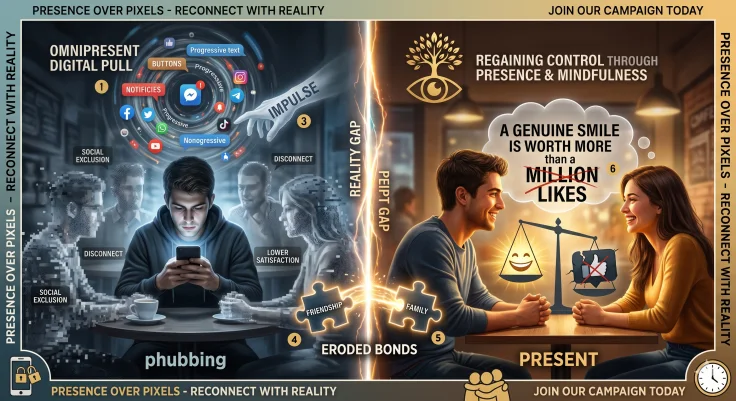
Read the following advertisement and mark the letter A, B, C or D on your answer sheet to indicate the option that best fits each of the numbered blanks from 1 to 6.
Reconnect with Reality
⮚In today’s digital age, the (1)_________ nature of smartphones has created a global phenomenon known as phubbing. This habit, (2)_________ involves ignoring companions to browse social media, is silently eroding our social fabric.
⮚Many users struggle to resist the urge to follow an (3)_________ to check notifications, regardless of their surroundings. Conversations (4)_________ by phone usage often lead to feelings of social exclusion and lower satisfaction.
⮚Consequently, chronic phubbing can (5)_________ the emotional bonds between friends and family members. It is time to prioritize real-life interactions and practice mindfulness to regain control over your attention.
⮚After all, a genuine smile from the person sitting across from you is (6)_________ any digital "like" on a screen. Join our "Presence Over Pixels" campaign today to rediscover the beauty of being truly present.
https://time.com/j
Question 1:A. addictive B. addiction C. addict D. addictively
Question 2:A. which B. that C. whose D. whom
Question 3:A. impulse B. instinct C. inclination D. obsession
Question 4:A. interrupted B. have interrupted C. which interrupted D. interrupting
Question 5:A. break off B. fall through C. break down D. pull apart
Question 6:A. far more meaningful as B. far more meaningful than
C. far more meaningfully than D. so much more meaningful as
Question 1:A. addictive B. addiction C. addict D. addictively
Giải Thích: Kiến thức về từ loại
A. addictive – ĐÚNG – Tính từ đứng trước và bổ nghĩa cho danh từ "nature". Phù hợp về nghĩa: bản chất gây nghiện của điện thoại.
B. addiction – SAI – Danh từ sự nghiện ngập. Không thể đứng trước danh từ "nature" để đóng vai trò thuộc tính trong ngữ cảnh này.
C. addict – SAI – Danh từ chỉ người (người nghiện). Không phù hợp để mô tả đặc tính của vật thể là điện thoại thông minh.
D. addictively – SAI – Trạng từ. Trạng từ không đứng trực tiếp trước danh từ để bổ nghĩa; nó thường bổ nghĩa cho động từ hoặc tính từ.
Tạm dịch: In today’s digital age, the addictive nature of smartphones has created a global phenomenon known as phubbing. ("Trong thời đại kỹ thuật số ngày nay, bản chất gây nghiện của điện thoại thông minh đã tạo ra một hiện tượng toàn cầu được gọi là phubbing.")
Question 2:A. which B. that C. whose D. whom
Giải Thích: Kiến thức về MĐQH
A. which – ĐÚNG – Đại từ quan hệ thay thế cho danh từ chỉ vật "This habit". Do có dấu phẩy nên đây là mệnh đề quan hệ không xác định.
B. that – SAI – Trong mệnh đề quan hệ không xác định (có dấu phẩy ngăn cách), không được phép sử dụng đại từ quan hệ "that".
C. whose – SAI – Đại từ quan hệ chỉ sở hữu, bắt buộc phải có một danh từ theo sau. Sau chỗ trống là động từ "involves".
D. whom – SAI – Đại từ quan hệ thay thế cho danh từ chỉ người đóng vai trò tân ngữ. "This habit" là vật nên loại ngay.
Tạm dịch: This habit, which involves ignoring companions to browse social media, is silently eroding our social fabric. ("Thói quen này, cái mà bao gồm việc phớt lờ những người đồng hành để lướt mạng xã hội, đang âm thầm hủy hoại kết cấu xã hội của chúng ta.")
Question 3:A. impulse B. instinct C. inclination D. obsession
Giải Thích: Kiến thức về từ vựng – nghĩa của từ
A. impulse – ĐÚNG – Danh từ mang nghĩa sự thôi thúc, cơn bốc đồng. Cụm "follow an impulse" (làm theo sự thôi thúc nhất thời) rất tự nhiên.
B. instinct – SAI – Danh từ mang nghĩa bản năng. Việc kiểm tra thông báo điện thoại là một thói quen hình thành, không phải bản năng sinh học tự nhiên.
C. inclination – SAI – Danh từ chỉ khuynh hướng hoặc thiên hướng. Thường dùng cho sở thích hoặc thái độ lâu dài hơn là một hành động bộc phát.
D. obsession – SAI – Danh từ chỉ sự ám ảnh. Ngữ cảnh đang nói về việc không cưỡng lại được một tác động tâm lý nhất thời khi có thông báo.
Tạm dịch: Many users struggle to resist the urge to follow an impulse to check notifications, regardless of their surroundings. ("Nhiều người dùng gặp khó khăn trong việc cưỡng lại sự thôi thúc kiểm tra thông báo, bất kể môi trường xung quanh họ.")
Question 4:A. interrupted B. have interrupted C. which interrupted D. interrupting
Giải Thích: Kiến thức về rút gọn MĐQH
A. interrupted – ĐÚNG – Rút gọn mệnh đề quan hệ dạng bị động (V3/ed). Câu gốc là: "Conversations which are interrupted by phone usage...".
B. have interrupted – SAI – Chia thì hiện tại hoàn thành chủ động. Sai cấu trúc câu vì chủ ngữ "Conversations" (cuộc hội thoại) phải là đối tượng bị tác động.
C. which interrupted – SAI – Thiếu động từ to-be "were/are" để tạo thành câu bị động đầy đủ sau đại từ quan hệ "which".
D. interrupting – SAI – Rút gọn mệnh đề quan hệ dạng chủ động (V-ing). Cuộc hội thoại không thể tự thực hiện hành động gây ngắt quãng.
Tạm dịch: Conversations interrupted by phone usage often lead to feelings of social exclusion and lower satisfaction. ("Các cuộc hội thoại bị gián đoạn do sử dụng điện thoại thường dẫn đến cảm giác bị loại trừ khỏi xã hội và sự hài lòng thấp hơn.")
Question 5:A. break off B. fall through C. break down D. pull apart
Giải Thích: Kiến thức về cụm động từ
A. break off – SAI – Cụm động từ thường dùng cho việc chấm dứt đột ngột một cuộc đàm phán hoặc làm gãy lìa một mảnh vật chất.
B. fall through – SAI – Cụm động từ chỉ kế hoạch hoặc thỏa thuận bị thất bại, không diễn ra được. Không dùng cho các liên kết tình cảm.
C. break down – ĐÚNG – Cụm động từ mang nghĩa làm suy yếu, làm tan vỡ hoặc làm hỏng (mối quan hệ, rào cản, hệ thống máy móc).
D. pull apart – SAI – Mang nghĩa kéo tách ra hoặc chia rẽ về mặt không gian. Không đi kèm tự nhiên với danh từ "emotional bonds".
Tạm dịch: Consequently, chronic phubbing can break down the emotional bonds between friends and family members. ("Hệ quả là, việc phubbing mãn tính có thể làm tan vỡ các mối liên kết tình cảm giữa bạn bè và các thành viên trong gia đình.")
Question 6:A. far more meaningful asB. far more meaningful than
C. far more meaningfully than D. so much more meaningful as
Giải Thích: Kiến thức về cấu trúc câu
A. far more meaningful as – SAI – Cấu trúc so sánh hơn bắt buộc dùng "than", không dùng "as". Từ "as" chỉ xuất hiện trong cấu trúc so sánh bằng.
B. far more meaningful than – ĐÚNG – Cấu trúc so sánh hơn với tính từ dài (more + adj + than). Từ "far" dùng để nhấn mạnh mức độ so sánh.
C. far more meaningfully than – SAI – "Meaningfully" là trạng từ. Sau động từ to-be "is" ta cần một tính từ để đóng vai trò làm vị ngữ cho câu.
D. so much more meaningful as – SAI – Sai cấu trúc so sánh. Tương tự câu A, cấu trúc so sánh hơn với "more" không thể đi với "as".
Tạm dịch: After all, a genuine smile from the person sitting across from you is far more meaningful than any digital "like" on a screen. ("Sau tất cả, một nụ cười chân thành từ người ngồi đối diện bạn ý nghĩa hơn nhiều so với bất kỳ lượt 'thích' kỹ thuật số nào trên màn hình.")
Read of the following leaflet and mark the letter A, B, C or D on your answer sheet to indicate the option that best fits each of the numbered blanks from 7 to 12.
Breaking the Silence of Echoism
⮚Are you living in the shadow of narcissism? Many individuals currently suffer from a (7)_________ known as echoism. (8)_________ narcissists constantly crave the spotlight, echoists survive by making themselves invisible to avoid attention.
⮚This psychological condition often stems from a (9)_________ fear of being perceived as demanding or selfish. Consequently, echoists are highly (10)_________ to self-criticism, often putting the needs of others above their own desires.
⮚Unfortunately, this self-erasure occurs (11)_________ the expense of one’s emotional well-being and personal growth. (12)_________ crucial step toward healing is recognizing that expressing your needs does not make you a narcissist. It is time to reclaim your voice and build healthier, more balanced relationships.
❖Join our workshop to rediscover your true self and move beyond the silence.
https://www.sciencefocus.com/j
Question 7:A. personality silent struggle B. struggle personality silent
C. silent struggle personality D. silent personality struggle
Question 8:A. Nevertheless B. Otherwise C. Whereas D. Unlike
Question 9:A. deep-set B. deep-seated C. deep-down D. deep-felt
Question 10:A. prone B. vulnerable C. susceptible D. liable
Question 11:A. to B. with C. for D. at
Question 12:A. The others B. Others C. Other D. Another
Question 7:A. personality silent struggle B. struggle personality silent
C. silent struggle personality D. silent personality struggle
Giải Thích: Kiến thức về trật tự từ
A. personality silent struggle – SAI – Sai trật tự tính từ. Tính từ miêu tả đặc điểm (silent) phải đứng trước danh từ đóng vai trò bổ ngữ (personality).
B. struggle personality silent – SAI – Cấu trúc lộn xộn. Danh từ chính "struggle" phải đứng ở cuối cụm danh từ để các từ khác bổ trợ.
C. silent struggle personality – SAI – Danh từ chính ở đây là "struggle" (cuộc đấu tranh), "personality" phải đứng ngay trước nó để bổ nghĩa trực tiếp.
D. silent personality struggle – ĐÚNG – Trật tự cụm danh từ: Tính từ miêu tả (silent) + Danh từ bổ nghĩa (personality) + Danh từ chính (struggle).
Tạm dịch: Many individuals currently suffer from a silent personality struggle known as echoism. ("Nhiều cá nhân hiện đang phải chịu đựng một cuộc đấu tranh nhân cách thầm lặng được gọi là echoism.")
Question 8:A. Nevertheless B. OtherwiseC. Whereas D. Unlike
Giải Thích: Kiến thức về liên từ
A. Nevertheless – SAI – Trạng từ liên kết mang nghĩa "tuy nhiên", thường đứng đầu câu và phải có dấu phẩy để nối hai câu độc lập về ngữ pháp.
B. Otherwise – SAI – Liên từ mang nghĩa "nếu không thì". Không phù hợp để diễn tả sự đối lập giữa hai kiểu tính cách trong cùng một ngữ cảnh.
C. Whereas – ĐÚNG – Liên từ dùng để nối hai mệnh đề có nội dung tương phản, đối lập trực tiếp (nghĩa là: trong khi đó).
D. Unlike – SAI – Giới từ mang nghĩa "không giống như". Sau "Unlike" chỉ được phép đi với một cụm danh từ, không đi với một mệnh đề.
Tạm dịch: Whereas narcissists constantly crave the spotlight, echoists survive by making themselves invisible to avoid attention. ("Trong khi những người ái kỷ liên tục khao khát sự chú ý, những người echoist tồn tại bằng cách khiến mình trở nên vô hình để tránh sự chú ý.")
Question 9:A. deep-setB. deep-seated C. deep-down D. deep-felt
Giải Thích: Kiến thức về từ vựng – nghĩa của từ
A. deep-set – SAI – Tính từ thường dùng để mô tả đặc điểm vật lý, ví dụ như đôi mắt nằm sâu trong hốc mắt (deep-set eyes).
B. deep-seated – ĐÚNG – Tính từ ghép mang nghĩa ăn sâu vào tiềm thức, khó thay đổi. Thường đi kèm với các danh từ như nỗi sợ, niềm tin.
C. deep-down – SAI – Thường đóng vai trò trạng từ mang nghĩa tận sâu trong lòng. Không dùng làm tính từ ghép đứng trước danh từ như cấu trúc này.
D. deep-felt – SAI – Cách dùng này không phổ biến và không chính xác bằng "deep-seated" khi mô tả một tình trạng tâm lý lâu đời như nỗi sợ.
Tạm dịch: This psychological condition often stems from a deep-seated fear of being perceived as demanding or selfish. ("Tình trạng tâm lý này thường bắt nguồn từ một nỗi sợ ăn sâu vào tiềm thức là bị coi là đòi hỏi hay ích kỷ.")
Question 10:A. prone B. vulnerable C. susceptible D. liable
Giải Thích: Kiến thức về từ vựng – nghĩa của từ
A. prone – ĐÚNG – Tính từ đi với giới từ "to" (prone to something), mang nghĩa có khuynh hướng hoặc dễ bị mắc phải cái gì đó tiêu cực.
B. vulnerable – SAI – Tính từ mang nghĩa dễ bị tổn thương. Thường thiên về việc bị tấn công từ bên ngoài hơn là một thói quen tâm lý tự thân.
C. susceptible – SAI – Tính từ mang nghĩa nhạy cảm hoặc dễ bị ảnh hưởng. Thường dùng trong ngữ cảnh y tế (dễ nhiễm bệnh) hơn là tâm lý học.
D. liable – SAI – Tính từ mang nghĩa có khả năng xảy ra hoặc chịu trách nhiệm pháp lý. Không phù hợp khi nói về xu hướng tự chỉ trích.
Tạm dịch: Consequently, echoists are highly prone to self-criticism, often putting the needs of others above their own desires. ("Hệ quả là, những người echoist rất dễ tự chỉ trích bản thân, thường đặt nhu cầu của người khác lên trên mong muốn của chính mình.")
Question 11:A. to B. with C. forD. at
Giải Thích: Kiến thức về giới từ
A. to – SAI – Giới từ "to" không đi kèm với danh từ "expense" để tạo thành cụm từ chỉ sự trả giá hay đánh đổi.
B. with – SAI – Giới từ "with" không nằm trong cấu trúc cố định liên quan đến tổn hại hay chi phí trong ngữ cảnh tâm lý này.
C. for – SAI – Giới từ "for" thường chỉ mục đích hoặc giá cả trong giao dịch, không dùng trong cụm từ chỉ sự đánh đổi về hạnh phúc.
D. at – ĐÚNG – Cấu trúc cố định "at the expense of something" mang nghĩa: phải trả giá bằng cái gì hoặc gây tổn hại cho cái gì.
Tạm dịch: Unfortunately, this self-erasure occurs at the expense of one’s emotional well-being and personal growth. ("Thật không may, sự tự xóa bỏ bản thân này xảy ra với cái giá phải trả là sức khỏe cảm xúc và sự phát triển cá nhân của chính họ.")
Question 12:A. The others B. Others C. OtherD. Another
Giải Thích: Kiến thức về lượng từ
A. The others – SAI – Đại từ thay thế cho những đối tượng còn lại trong một nhóm xác định. Không đứng trước danh từ số ít "step".
B. Others – SAI – Đại từ thay thế cho những đối tượng khác nói chung. Không thể đứng trước danh từ số ít để làm từ hạn định.
C. Other – SAI – Hạn định từ này bắt buộc đi với danh từ đếm được số nhiều hoặc danh từ không đếm được. "Step" ở đây là số ít.
D. Another – ĐÚNG – Từ hạn định đi với danh từ đếm được số ít (another + N-singular), mang nghĩa "một cái nữa" trong một loạt các bước.
Tạm dịch: Another crucial step toward healing is recognizing that expressing your needs does not make you a narcissist. ("Một bước quan trọng khác để chữa lành là nhận ra rằng việc bày tỏ nhu cầu của bạn không biến bạn thành một người ái kỷ.")
Mark the letter A, B, C or D on your answer sheet to indicate the best arrangement of utterances or sentences to make a meaningful exchange or text in each of the following questions from 13 to 17.
Question 13:
A. Alex: True, it makes every walk in nature feel like I'm stepping on top of a giant, undiscovered puzzle.
B. Alex: I just read that archaeologists found a massive lost city hidden right under a thick jungle!
C. Jamie: It's fascinating that even with all our modern technology, the earth still keeps so many secrets.
A. b-a-c B. c-b-a C. a-b-c D. b-c-a
Question 14:
A. Lan: I agree completely, so we should support international conservation groups that work hard to protect these threatened ecosystems from further harm.
B. Minh: Did you know that biodiversity hotspots cover only about two percent of the Earth’s surface, although they are home to more than half of the world’s unique plant and animal species?
C. Lan: That is truly amazing, but we must remember that these precious regions are facing extreme danger because human activities are destroying their natural balance.
D. Minh: Protecting these hotspots is vital because our own future depends on the health and diversity of the natural world that surrounds us.
e. Minh: If we continue to ignore the destruction of these habitats, thousands of rare creatures will disappear forever before we even have a chance to study them.
A. c-d-b-e-a B. b-c-e-a-d C. b-e-d-a-c D. a-e-b-c-d
Question 15:
Dear Leo,
A. Although most people imagine a future filled with flying cars, I am personally more interested in smart transit systems, which will connect distant metropolises in just a few minutes.
B. As our current cities continue to grow rapidly, I often wonder how the urban landscape will transform once advanced technology begins to reshape every aspect of our daily lives.
C. Even if some residents worry about their privacy in these high-tech environments, the integration of AI will likely ensure that everyone feels much safer within their own communities.
D. Please let me know what you think about these urban evolutions when you have a moment to reply to this letter.
e. Many architects suggest that vertical forests will eventually dominate the skyline because they provide a natural and sustainable solution to air pollution in densely populated areas.
Best regards,
J
A. a-c-e-b-d B. b-e-a-c-d C. d-c-a-e-b D. e-b-c-a-d
Question 16:
A. If Vietnam continues to foster a favorable business environment and encourages constant innovation, its SMEs will undoubtedly play a crucial role in driving regional economic growth in the future.
B. Although small and medium enterprises (SMEs) account for the vast majority of businesses in Vietnam, they still face significant structural challenges when they try to expand into competitive international markets.
C. Successful entrepreneurs have learned that they must prioritize high product quality and digital transformation, or they will surely struggle to compete with established brands from neighboring countries like Thailand.
D. Since the ASEAN Economic Community provides a massive consumer base and lower trade barriers, Vietnamese firms can now reach millions of new customers more easily than they ever could before.
e. While the government is offering various support programs to help local businesses, SMEs should also actively seek strategic partnerships with regional players to gain valuable market insights and experience.
A. e-d-c-b-a B. b-d-c-e-a C. d-e-b-c-a D. c-b-e-d-a
Question 17:
A. Since these animals rely on specific habitats for feeding and breeding during their long journeys, the destruction of a single wetland can devastate an entire population.
B. If researchers use satellite technology to track these movements accurately, they can pinpoint the exact areas that need immediate protection from urban development or hunting.
C. Migratory species often travel thousands of miles across many different countries, which means that local conservation efforts are never enough to ensure their long-term survival.
D. We must treat the protection of these travelers as a shared global responsibility, so nations should work together to preserve these incredible natural wonders for future generations.
e. Human activities like climate change and pollution are disrupting their ancient routes, but global treaties can help by establishing protected corridors that cross national borders.
A. c-e-b-d-a B. c-b-d-a-e C. c-a-e-b-d D. c-b-a-e-d
A. Alex: True, it makes every walk in nature feel like I'm stepping on top of a giant, undiscovered puzzle.
B. Alex: I just read that archaeologists found a massive lost city hidden right under a thick jungle!
C. Jamie: It's fascinating that even with all our modern technology, the earth still keeps so many secrets.
A. b-a-c B. c-b-a C. a-b-c D. b-c-a
Giải Thích: Kiến thức về sắp xếp câu tạo thành đoạn hội thoại
B. Alex mở đầu cuộc hội thoại bằng cách chia sẻ một thông tin vừa đọc được về khảo cổ học ("I just read that...").
C. Jamie đưa ra nhận xét về sự kỳ bí của trái đất ("keeps so many secrets") để phản hồi lại thông tin khám phá ở câu B.
A. Alex sử dụng "True" để đồng ý với Jamie và dùng hình ảnh so sánh "puzzle" để khép lại ý tưởng về những bí ẩn chưa được giải đáp.
Question 14:
A. Lan: I agree completely, so we should support international conservation groups that work hard to protect these threatened ecosystems from further harm.
B. Minh: Did you know that biodiversity hotspots cover only about two percent of the Earth’s surface, although they are home to more than half of the world’s unique plant and animal species?
C. Lan: That is truly amazing, but we must remember that these precious regions are facing extreme danger because human activities are destroying their natural balance.
D. Minh: Protecting these hotspots is vital because our own future depends on the health and diversity of the natural world that surrounds us.
e. Minh: If we continue to ignore the destruction of these habitats, thousands of rare creatures will disappear forever before we even have a chance to study them.
A. c-d-b-e-a B. b-c-e-a-d C. b-e-d-a-c D. a-e-b-c-d
Giải Thích: Kiến thức về sắp xếp câu tạo thành đoạn hội thoại
B. Minh mở đầu bằng việc cung cấp số liệu thống kê thú vị về các điểm nóng đa dạng sinh học ("biodiversity hotspots").
C. Lan phản hồi tích cực ("That is truly amazing") nhưng lập tức chỉ ra thực trạng nguy hiểm do tác động của con người.
e. Minh tiếp nối bằng cách cảnh báo hậu quả nghiêm trọng ("disappear forever") nếu các môi trường sống này tiếp tục bị phớt lờ.
A. Lan thể hiện sự đồng tình ("I agree completely") và đề xuất hành động cụ thể là hỗ trợ các nhóm bảo tồn quốc tế.
D. Minh kết thúc đoạn hội thoại bằng việc khẳng định tầm quan trọng của đa dạng sinh học đối với tương lai của chính con người.
Question 15:
Dear Leo,
A. Although most people imagine a future filled with flying cars, I am personally more interested in smart transit systems, which will connect distant metropolises in just a few minutes.
B. As our current cities continue to grow rapidly, I often wonder how the urban landscape will transform once advanced technology begins to reshape every aspect of our daily lives.
C. Even if some residents worry about their privacy in these high-tech environments, the integration of AI will likely ensure that everyone feels much safer within their own communities.
D. Please let me know what you think about these urban evolutions when you have a moment to reply to this letter.
e. Many architects suggest that vertical forests will eventually dominate the skyline because they provide a natural and sustainable solution to air pollution in densely populated areas.
Best regards,
J
A. a-c-e-b-d B. b-e-a-c-d C. d-c-a-e-b D. e-b-c-a-d
Giải Thích: Kiến thức về sắp xếp câu tạo thành bức thư
B. Người viết bắt đầu bằng một quan sát chung về sự phát triển đô thị và đặt câu hỏi về sự thay đổi của cảnh quan thành phố.
e. Giới thiệu một xu hướng cụ thể là rừng thẳng đứng ("vertical forests") như một giải pháp bền vững cho ô nhiễm không khí.
A. Sử dụng "Although" để chuyển hướng từ quan niệm phổ biến sang sở thích cá nhân về hệ thống vận chuyển thông minh ("smart transit systems").
C. Giải quyết lo ngại về quyền riêng tư bằng cách nêu bật lợi ích của AI trong việc đảm bảo an ninh cộng đồng.
D. Câu kết thư yêu cầu người nhận chia sẻ quan điểm cá nhân về những diễn biến đô thị đã nêu.
Question 16:
A. If Vietnam continues to foster a favorable business environment and encourages constant innovation, its SMEs will undoubtedly play a crucial role in driving regional economic growth in the future.
B. Although small and medium enterprises (SMEs) account for the vast majority of businesses in Vietnam, they still face significant structural challenges when they try to expand into competitive international markets.
C. Successful entrepreneurs have learned that they must prioritize high product quality and digital transformation, or they will surely struggle to compete with established brands from neighboring countries like Thailand.
D. Since the ASEAN Economic Community provides a massive consumer base and lower trade barriers, Vietnamese firms can now reach millions of new customers more easily than they ever could before.
e. While the government is offering various support programs to help local businesses, SMEs should also actively seek strategic partnerships with regional players to gain valuable market insights and experience.
A. e-d-c-b-a B. b-d-c-e-a C. d-e-b-c-a D. c-b-e-d-a
Giải Thích: Kiến thức về sắp xếp câu tạo thành đoạn văn
B. Giới thiệu về thực trạng và thách thức của các doanh nghiệp vừa và nhỏ (SMEs) tại Việt Nam khi ra thị trường quốc tế.
D. Chỉ ra một điều kiện thuận lợi cụ thể từ Cộng đồng Kinh tế ASEAN ("ASEAN Economic Community") với các rào cản thương mại thấp.
C. Nêu ra những yếu tố then chốt mà doanh nghiệp cần ưu tiên như chất lượng sản phẩm và chuyển đổi số để có thể cạnh tranh.
e. Đề xuất chiến lược tìm kiếm đối tác khu vực để tích lũy kinh nghiệm bên cạnh việc thụ hưởng các chương trình hỗ trợ của chính phủ.
A. Kết luận bằng cấu trúc câu điều kiện loại 1 để khẳng định tiềm năng đóng góp của SMEs vào tăng trưởng kinh tế vùng.
Question 17:
A. Since these animals rely on specific habitats for feeding and breeding during their long journeys, the destruction of a single wetland can devastate an entire population.
B. If researchers use satellite technology to track these movements accurately, they can pinpoint the exact areas that need immediate protection from urban development or hunting.
C. Migratory species often travel thousands of miles across many different countries, which means that local conservation efforts are never enough to ensure their long-term survival.
D. We must treat the protection of these travelers as a shared global responsibility, so nations should work together to preserve these incredible natural wonders for future generations.
e. Human activities like climate change and pollution are disrupting their ancient routes, but global treaties can help by establishing protected corridors that cross national borders.
A. c-e-b-d-a B. c-b-d-a-e C. c-a-e-b-d D. c-b-a-e-d
Giải Thích: Kiến thức về sắp xếp câu tạo thành đoạn văn
C. Giới thiệu chủ đề về các loài di cư ("Migratory species") và sự cần thiết của sự hợp tác đa quốc gia trong bảo tồn.
A. Sử dụng đại từ thay thế "these animals" để giải thích tầm quan trọng của các điểm dừng chân cụ thể như vùng đất ngập nước.
e. Phân tích tác động của con người đến lộ trình di cư và đề xuất giải pháp thông qua các hiệp ước toàn cầu ("global treaties").
B. Chỉ ra giải pháp kỹ thuật là sử dụng công nghệ vệ tinh để xác định chính xác các khu vực cần được bảo vệ ưu tiên.
D. Kết thúc bằng lời kêu gọi coi việc bảo tồn là trách nhiệm chung toàn cầu nhằm gìn giữ kỳ quan thiên nhiên cho tương lai.
Read the following passage about Understanding "Brain Rot" and mark the letter A, B, C or D on your answer sheet to indicate the option that best fits each of the numbered blanks from 18 to 22.
The official recognition of "brain rot" as the Word of the Year by Oxford University Press underscores a profound saturation of mindless digital content in contemporary society, forcing us to confront our screen habits. (18)_________ that has triggered a massive 290% surge in the term's frequency; (19)_________. This linguistic phenomenon, which reflects a deep-seated anxiety regarding our increasingly hyper-digital existence, serves as a powerful critique of a culture prioritizing sheer quantity over intellectual substance. (20)_________, arguably, remains a significant concern for educators and psychologists worldwide. While many young people find the label humorous, others view it as a serious warning about the detrimental long-term effects of an ephemeral digital diet on human brain development. (21)_________; nevertheless, they frequently struggle to reclaim their cognitive focus from the pervasive platforms that dominate their lives. This constant preoccupation with low-quality media highlights the intellectual deterioration caused by a lack of focus. Ultimately, the crowning of "brain rot" symbolizes a pivotal moment (22)_________. We must learn to navigate this digital landscape carefully to preserve our mental well-being before the damage becomes irreversible and permanent for future generations. This linguistic choice reflects a collective desire to protect our minds from being numbed by mindless screens forever. Let's choose presence over pixels today.
https://www.theguardian.com/j
Question 18:
A. It is the relentless pursuit of "click-bait" engagement and algorithm-driven videos
B. It is the widespread availability of "click-bait" content and algorithm-driven platforms
C. It is the increasing demand for "click-bait" engagement and algorithm-driven content
D. It is the rapid expansion of "click-bait" media and algorithm-driven networks
Question 19:
A. as a result, the public now uses it to articulate differing perceptions of digital engagement fatigue
B. thus, the public now uses it to articulate a shared sense of digital exhaustion and fatigue under certain conditions
C. consequently, the public now uses it to articulate a broadly shared sense of digital exhaustion and fatigue in niche contexts
D. consequently, the public now uses it to articulate a shared sense of digital exhaustion and fatigue
Question 20:
A. Whether our collective critical thinking skills are being slowly eroded by such addictive habits
B. That our collective critical thinking skills are being slowly eroded by such addictive habits
C. How our collective critical thinking skills are being slowly eroded by such addictive habits
D. Why our collective critical thinking skills are being slowly eroded by such addictive habits
Question 21:
A. Users often feel briefly overwhelmed yet still attentive after several hours of endless scrolling
B. Users often feel emotionally engaged but mentally stable after several hours of endless scrolling
C. Users often feel mentally numbed and disconnected after several hours of endless scrolling
D. Users often feel mildly distracted and cognitively slower after several hours of endless scrolling
Question 22:
A. which represents society finally acknowledging the massive depravity of modern attention spans
B. that will eventually illustrate the massive depravity of modern attention spans
C. where society finally acknowledges the massive depravity of modern attention spans
D. which had previously illustrated the massive depravity of modern attention spans
A. It is the relentless pursuit of "click-bait" engagement and algorithm-driven videos
B. It is the widespread availability of "click-bait" content and algorithm-driven platforms
C. It is the increasing demand for "click-bait" engagement and algorithm-driven content
D. It is the rapid expansion of "click-bait" media and algorithm-driven networks
Giải Thích: Kiến thức về cấu trúc câu
A. It is the relentless pursuit of "click-bait" engagement and algorithm-driven videos – ĐÚNG – Cấu trúc câu chẻ It is... that... được sử dụng chính xác để nhấn mạnh nguyên nhân cốt lõi dẫn đến sự bùng nổ của thuật ngữ. Nội dung về sự theo đuổi lượt tương tác ảo phù hợp hoàn hảo với số liệu gia tăng tần suất sử dụng được nêu ở vế sau.
B. It is the widespread availability of "click-bait" content and algorithm-driven platforms – SAI – Mặc dù đúng về mặt ngữ pháp nhưng nội dung về sự sẵn có của nội dung chỉ mang tính chất mô tả trạng thái khách quan. Nó không thể hiện được tính chủ động và tác động mạnh mẽ để dẫn đến một sự thay đổi đột biến trong ngôn ngữ xã hội.
C. It is the increasing demand for "click-bait" engagement and algorithm-driven content – SAI – Lựa chọn này sai về mặt logic ngữ nghĩa khi cho rằng chính người dùng có nhu cầu chủ động đối với các nội dung gây hại. Bài viết đang tập trung phê phán cách thức các thuật toán và nhà sáng tạo nội dung đang ép buộc công chúng tiếp nhận.
D. It is the rapid expansion of "click-bait" media and algorithm-driven networks – SAI – Cụm từ mở rộng mạng lưới chỉ đề cập đến khía cạnh hạ tầng kỹ thuật hoặc quy mô vật lý của các phương tiện truyền thông. Nó không phản ánh được bản chất hành vi thu hút sự chú ý rẻ tiền vốn là trọng tâm gây ra hiện tượng brain rot này.
Tạm dịch: It is the relentless pursuit of "click-bait" engagement and algorithm-driven videos that has triggered a massive 290% surge in the term's frequency. ("Chính sự theo đuổi không ngừng nghỉ các lượt tương tác câu khách và các video do thuật toán thúc đẩy đã gây ra sự gia tăng đột biến 290% về tần suất sử dụng thuật ngữ này.")
Question 19:
A. as a result, the public now uses it to articulate differing perceptions of digital engagement fatigue
B. thus, the public now uses it to articulate a shared sense of digital exhaustion and fatigue under certain conditions
C. consequently, the public now uses it to articulate a broadly shared sense of digital exhaustion and fatigue in niche contexts
D. consequently, the public now uses it to articulate a shared sense of digital exhaustion and fatigue
Giải Thích: Kiến thức về mệnh đề độc lập – nghĩa của câu
A. as a result, the public now uses it to articulate differing perceptions of digital engagement fatigue – SAI – Trạng từ chỉ kết quả as a result dùng đúng để nối mệnh đề nhưng nội dung differing perceptions lại gây ra sự mâu thuẫn. Bài viết đang muốn nhấn mạnh vào một sự đồng thuận chung của đại chúng về trạng thái kiệt sức kỹ thuật số hiện nay.
B. thus, the public now uses it to articulate a shared sense of digital exhaustion and fatigue under certain conditions – SAI – Trạng từ thus tạo mối quan hệ nhân quả hợp lý nhưng cụm từ under certain conditions lại làm thu hẹp phạm vi của vấn đề quá mức. Thực trạng mệt mỏi kỹ thuật số đang là vấn đề mang tính hệ thống toàn cầu chứ không chỉ ở một vài điều kiện.
C. consequently, the public now uses it to articulate a broadly shared sense of digital exhaustion and fatigue in niche contexts – SAI – Trạng từ chỉ hệ quả consequently được dùng tốt nhưng cụm từ in niche contexts lại hoàn toàn sai lệch về mặt ngữ nghĩa. Sự kiệt sức kỹ thuật số là một trải nghiệm đại chúng rộng khắp chứ không chỉ xuất hiện trong những bối cảnh nhỏ lẻ.
D. consequently, the public now uses it to articulate a shared sense of digital exhaustion and fatigue – ĐÚNG – Liên từ chỉ kết quả tạo sự kết nối logic chặt chẽ với sự gia tăng tần suất sử dụng thuật ngữ ở mệnh đề trước. Cụm từ shared sense phản ánh chính xác sự đồng cảm rộng rãi của mọi người về tình trạng kiệt sức do công nghệ gây ra.
Tạm dịch: Consequently, the public now uses it to articulate a shared sense of digital exhaustion and fatigue. ("Hệ quả là, công chúng hiện đang sử dụng nó để thể hiện cảm giác chung về sự kiệt sức và mệt mỏi kỹ thuật số.")
Question 20:
A. Whether our collective critical thinking skills are being slowly eroded by such addictive habits
B. That our collective critical thinking skills are being slowly eroded by such addictive habits
C. How our collective critical thinking skills are being slowly eroded by such addictive habits
D. Why our collective critical thinking skills are being slowly eroded by such addictive habits
Giải Thích: Kiến thức về MĐQH
A. Whether our collective critical thinking skills are being slowly eroded by such addictive habits – SAI – Mệnh đề danh ngữ bắt đầu bằng Whether dùng để diễn đạt một sự nghi ngờ giữa hai khả năng xảy ra. Trong khi đó, ngữ cảnh của bài viết đang khẳng định một thực trạng tiêu cực rõ ràng chứ không phải đặt ra một câu hỏi nghi vấn chưa có lời giải.
B. That our collective critical thinking skills are being slowly eroded by such addictive habits – ĐÚNG – Mệnh đề danh ngữ bắt đầu bằng That biến một sự việc thành chủ ngữ của câu nhằm khẳng định một thực trạng chắc chắn. Cấu trúc này làm nổi bật nội dung về sự xói mòn khả năng tư duy phản biện do các thói quen kỹ thuật số gây nghiện.
C. How our collective critical thinking skills are being slowly eroded by such addictive habits – SAI – Mệnh đề danh ngữ bắt đầu bằng How tập trung mô tả phương thức hoặc quá trình thực hiện hành động. Bài viết này đang muốn nhấn mạnh trực diện vào bản chất của sự việc đáng lo ngại chứ không đi sâu vào phân tích quy trình xói mòn diễn ra ra sao.
D. Why our collective critical thinking skills are being slowly eroded by such addictive habits – SAI – Mệnh đề danh ngữ bắt đầu bằng Why tập trung giải thích lý do hoặc nguyên nhân sâu xa của một vấn đề. Việc đưa từ để hỏi này vào làm chủ ngữ sẽ khiến câu văn trở nên nặng nề và không đi thẳng vào thực trạng tiêu cực mà các chuyên gia đang lo lắng.
Tạm dịch: That our collective critical thinking skills are being slowly eroded by such addictive habits, arguably, remains a significant concern for educators and psychologists worldwide. ("Việc các kỹ năng tư duy phản biện tập thể của chúng ta đang dần bị xói mòn bởi những thói quen gây nghiện như vậy, có thể nói, vẫn là một mối lo ngại lớn đối với các nhà giáo dục và tâm lý học trên toàn thế giới.")
Question 21:
A. Users often feel briefly overwhelmed yet still attentive after several hours of endless scrolling
B. Users often feel emotionally engaged but mentally stable after several hours of endless scrolling
C. Users often feel mentally numbed and disconnected after several hours of endless scrolling
D. Users often feel mildly distracted and cognitively slower after several hours of endless scrolling
Giải Thích: Kiến thức về mệnh đề độc lập – nghĩa của câu
A. Users often feel briefly overwhelmed yet still attentive after several hours of endless scrolling – SAI – Nội dung mệnh đề này khẳng định người dùng vẫn giữ được sự chú ý sau nhiều giờ lướt mạng xã hội. Điều này mâu thuẫn trực tiếp với trạng từ nevertheless ở mệnh đề sau khi nói về việc họ rất khó khăn để lấy lại sự tập trung nhận thức.
B. Users often feel emotionally engaged but mentally stable after several hours of endless scrolling – SAI – Cụm từ mentally stable cho rằng người dùng vẫn ổn định về mặt tinh thần sau khi sử dụng mạng quá độ là không đúng. Ý kiến này hoàn toàn đi ngược lại với ý nghĩa của thuật ngữ brain rot và những cảnh báo về tác hại trong toàn bộ đoạn văn.
C. Users often feel mentally numbed and disconnected after several hours of endless scrolling – ĐÚNG – Mệnh đề này mô tả chính xác trạng thái tê liệt tinh thần và mất kết nối sau khi tiếp nhận quá nhiều nội dung số kém chất lượng. Nó tạo ra sự tương đương về mặt logic với nỗ lực giành lại sự tập trung nhận thức được đề cập ở mệnh đề ngay sau đó.
D. Users often feel mildly distracted and cognitively slower after several hours of endless scrolling – SAI – Trạng thái mildly distracted là quá nhẹ nhàng và không phản ánh đúng mức độ nghiêm trọng mà bài viết đang truyền tải. Nó không đủ sức nặng để làm tiền đề cho sự đối lập với việc đấu tranh vô vọng để kiểm soát tâm trí ở vế sau của câu.
Tạm dịch: Users often feel mentally numbed and disconnected after several hours of endless scrolling; nevertheless, they frequently struggle to reclaim their cognitive focus from the pervasive platforms that dominate their lives. ("Người dùng thường cảm thấy tê liệt về tinh thần và mất kết nối sau vài giờ lướt mạng không ngừng nghỉ; tuy nhiên, họ thường phải vật lộn để giành lại sự tập trung nhận thức từ các nền tảng phổ biến đang thống trị cuộc sống của họ.")
Question 22:
A. which represents society finally acknowledging the massive depravity of modern attention spans
B. that will eventually illustrate the massive depravity of modern attention spans
C. where society finally acknowledges the massive depravity of modern attention spans
D. which had previously illustrated the massive depravity of modern attention spans
Giải Thích: Kiến thức về MĐQH
A. which represents society finally acknowledging the massive depravity of modern attention spans – SAI – Đại từ quan hệ which dùng để thay thế cho một danh từ chỉ vật hoặc cả mệnh đề đứng trước. Trong ngữ cảnh nhấn mạnh vào một thời điểm lịch sử là pivotal moment, việc sử dụng đại từ này không chính xác và tự nhiên bằng một trạng từ quan hệ chỉ thời gian.
B. that will eventually illustrate the massive depravity of modern attention spans – SAI – Việc sử dụng thì tương lai sẽ minh họa làm giảm đi tính thời sự và cấp bách của sự kiện. Việc Oxford công bố từ của năm là một sự kiện đang diễn ra và nó trực tiếp phản ánh thực trạng xã hội ngay tại thời điểm hiện tại của văn bản này.
C. where society finally acknowledges the massive depravity of modern attention spans – ĐÚNG – Trạng từ quan hệ where được dùng chính xác để bổ nghĩa cho danh từ moment khi nó mang sắc thái của một thời điểm hoặc hoàn cảnh. Nó dẫn dắt một mệnh đề giải thích rõ xã hội đang thừa nhận sự suy giảm nghiêm trọng của khả năng tập trung hiện nay.
D. which had previously illustrated the massive depravity of modern attention spans – SAI – Thì quá khứ hoàn thành had previously illustrated ám chỉ sự việc này đã kết thúc trước một thời điểm khác trong quá khứ. Điều này làm mất đi tính kết nối với lời kêu gọi hành động bảo vệ sức khỏe tinh thần và tương lai của thế hệ trẻ ở cuối đoạn văn.
Tạm dịch: Ultimately, the crowning of "brain rot" symbolizes a pivotal moment where society finally acknowledges the massive depravity of modern attention spans. ("Cuối cùng, việc tôn vinh brain rot tượng trưng cho một thời điểm then chốt khi xã hội cuối cùng cũng thừa nhận sự suy giảm nghiêm trọng của khả năng tập trung hiện đại.")
BẢNG TẠM DỊCH SONG NGỮ
English
Tiếng Việt
The official recognition of "brain rot" as the Word of the Year by Oxford University Press underscores a profound saturation of mindless digital content in contemporary society, forcing us to confront our screen habits. It is the relentless pursuit of "click-bait" engagement and algorithm-driven videos that has triggered a massive 290% surge in the term's frequency; consequently, the public now uses it to articulate a shared sense of digital exhaustion and fatigue. This linguistic phenomenon, which reflects a deep-seated anxiety regarding our increasingly hyper-digital existence, serves as a powerful critique of a culture prioritizing sheer quantity over intellectual substance.
Việc Oxford University Press chính thức công nhận brain rot là Từ của năm nhấn mạnh sự bão hòa sâu sắc của nội dung kỹ thuật số vô nghĩa trong xã hội đương đại, buộc chúng ta phải đối mặt với thói quen sử dụng màn hình của mình. Chính sự theo đuổi không ngừng nghỉ các lượt tương tác câu khách và các video do thuật toán thúc đẩy đã gây ra sự gia tăng đột biến 290% về tần suất sử dụng thuật ngữ này; hệ quả là, công chúng hiện đang sử dụng nó để thể hiện cảm giác chung về sự kiệt sức và mệt mỏi kỹ thuật số. Hiện tượng ngôn ngữ này, phản ánh một sự lo lắng sâu sắc về sự tồn tại kỹ thuật số ngày càng tăng của chúng ta, đóng vai trò như một lời phê bình mạnh mẽ đối với một nền văn hóa ưu tiên số lượng thuần túy hơn là nội dung trí tuệ.
That our collective critical thinking skills are being slowly eroded by such addictive habits, arguably, remains a significant concern for educators and psychologists worldwide. While many young people find the label humorous, others view it as a serious warning about the detrimental long-term effects of an ephemeral digital diet on human brain development. Users often feel mentally numbed and disconnected after several hours of endless scrolling; nevertheless, they frequently struggle to reclaim their cognitive focus from the pervasive platforms that dominate their lives. This constant preoccupation with low-quality media highlights the intellectual deterioration caused by a lack of focus.
Việc các kỹ năng tư duy phản biện tập thể của chúng ta đang dần bị xói mòn bởi những thói quen gây nghiện như vậy, có thể nói, vẫn là một mối lo ngại lớn đối với các nhà giáo dục và tâm lý học trên toàn thế giới. Trong khi nhiều người trẻ thấy nhãn dán này hài hước, những người khác lại coi đó là một lời cảnh báo nghiêm trọng về những tác động tiêu cực lâu dài của một chế độ ăn kỹ thuật số tạm bợ đối với sự phát triển não bộ con người. Người dùng thường cảm thấy tê liệt về tinh thần và mất kết nối sau vài giờ lướt mạng không ngừng nghỉ; tuy nhiên, họ thường phải vật lộn để giành lại sự tập trung nhận thức từ các nền tảng phổ biến đang thống trị cuộc sống của họ. Sự bận tâm liên tục với các phương tiện truyền thông chất lượng thấp này làm nổi bật sự suy thoái trí tuệ do thiếu tập trung gây ra.
Ultimately, the crowning of "brain rot" symbolizes a pivotal moment where society finally acknowledges the massive depravity of modern attention spans. We must learn to navigate this digital landscape carefully to preserve our mental well-being before the damage becomes irreversible and permanent for future generations. This linguistic choice reflects a collective desire to protect our minds from being numbed by mindless screens forever. Let's choose presence over pixels today.
Cuối cùng, việc tôn vinh brain rot tượng trưng cho một thời điểm then chốt khi xã hội cuối cùng cũng thừa nhận sự suy giảm nghiêm trọng của khả năng tập trung hiện đại. Chúng ta phải học cách điều hướng bối cảnh kỹ thuật số này một cách cẩn thận để bảo vệ sức khỏe tinh thần của mình trước khi thiệt hại trở nên không thể đảo ngược và vĩnh viễn đối với các thế hệ tương lai. Lựa chọn ngôn ngữ này phản ánh mong muốn tập thể nhằm bảo vệ trí óc của chúng ta khỏi bị làm tê liệt bởi những màn hình vô hồn mãi mãi. Hãy chọn sự hiện diện thay vì những điểm ảnh ngay hôm nay.
Read the following passage about The Lifecycle of Digital Decay and mark the letter A, B, C or D on your answer sheet to indicate the best answer to each of the following questions from 23 to 30.
Cory Doctorow’s "enshittification" theory elucidates the predatory trajectory of digital behemoths. This process begins with an alluring stage where platforms are subsidized by venture capital to entice a vast user base through high-quality services. By prioritizing consumer satisfaction initially, companies foster a sense of loyalty. However, this phase is merely a deceptive tactic, setting the foundation for future value removal from the ecosystem's unsuspecting participants and long-term profit goals.
Transitioning into the secondary phase, platforms pivot their focus toward business entities. By manipulating algorithms, they promise creators and advertisers immense reach, establishing a digital hegemony. Eventually, the final decay occurs as the platform prioritizes its own financial equilibrium over all else. Services become increasingly cluttered with low-quality content. Consequently, the user experience deteriorates significantly, as the once-helpful interface transforms into a tool for corporate greed and systemic exploitation for shareholders.
TikTok serves as a modern archetype of this decline. Initially celebrated for its precision, its "For You" feed now faces aggressive monetization through TikTok Shop. Users find themselves trapped by the "lock-in" effect, a psychological coercion where leaving means abandoning social connections. Even as the environment becomes "shitty," the perceived cost of exiting remains prohibitively high. This explains why monopolies continue to thrive despite offering a fundamentally broken service today worldwide.
Ultimately, Doctorow asserts that this degradation is a deliberate corporate choice rather than a technical failure. To combat this, we must demand accountability through stringent regulations. A pivotal solution involves interoperability, allowing users to migrate between services while maintaining their digital communities. By dismantling the barriers that prevent competition, we can challenge the dominance of Big Tech. We must stop relying on the benevolence of CEOs to protect the internet forever.
https://www.wired.com/j
Question 23: Which of the following is NOT mentioned in the text as a factor or a consequence of the "enshittification" process?
A. The initial subsidization of high-quality services to cultivate a substantial user base.
B. The strategic redirection of benefits toward business entities through algorithmic manipulation.
C. The unintended technical degradation resulting from a platform's inability to manage data.
D. The psychological coercion that prevents users from leaving despite a deteriorating experience.
Question 24: The word “entice” in paragraph 1 is OPPOSITE in meaning to _________.
A. deter B. captivate C. incentivize D. provoke
Question 25: The word “its” in paragraph 2 refers to _________.
A. the platform
B. the final decay
C. financial equilibrium
D. business entities
Question 26: The word “coercion” in paragraph 3 could be best replaced by _________.
A. willingness B. commitment C. limitation D. obligation
Question 27: Which of the following best paraphrases the underlined sentence in paragraph 4?
A. Vital remedies involve technical standardization, letting users switch providers while preserving networks.
B. Essential fixes require platform compatibility, empowering people to change ecosystems while keeping ties.
C. Key strategies demand systemic integration, allowing individuals to shift environments while maintaining circles.
D. Critical resolutions necessitate platform cross-functionality, enabling participants to exit monopolies while sustaining collectives.
Question 28: Which of the following is TRUE according to the passage?
A. Technical limitations primarily drive the progressive degradation of digital ecosystems.
B. Platform interoperability enables user migration without losing digital social circles.
C. Venture capital subsidies initially prioritize shareholder interests over user satisfaction.
D. Stronger government regulations are ultimately unnecessary to challenge platform monopolies.
Question 29: In which paragraph does the writer mention the strategic shift from serving external stakeholders to prioritizing the platform's own internal financial stability?
A. Paragraph 1 B. Paragraph 2 C. Paragraph 3 D. Paragraph 4
Question 30: In which paragraph does the writer mention a structural solution aimed at facilitating user migration without the loss of social connectivity?
A. Paragraph 2 B. Paragraph 1 C. Paragraph 4 D. Paragraph 3
Question 23: Which of the following is NOT mentioned in the text as a factor or a consequence of the "enshittification" process?
A. The initial subsidization of high-quality services to cultivate a substantial user base.
B. The strategic redirection of benefits toward business entities through algorithmic manipulation.
C. The unintended technical degradation resulting from a platform's inability to manage data.
D. The psychological coercion that prevents users from leaving despite a deteriorating experience.
Giải Thích: Điều nào sau đây không được đề cập trong văn bản như một yếu tố hoặc hậu quả của quá trình enshittification?
A. The initial subsidization of high-quality services to cultivate a substantial user base. – SAI – Bài viết có đề cập đến việc dùng vốn đầu tư để trợ cấp dịch vụ tốt nhằm thu hút người dùng. Trích dẫn cho thấy giai đoạn đầu các nền tảng được "subsidized by venture capital to entice a vast user base".
B. The strategic redirection of benefits toward business entities through algorithmic manipulation. – SAI – Thông tin này xuất hiện khi mô tả giai đoạn thứ hai của quá trình chuyển dịch trọng tâm. Văn bản nêu rõ các nền tảng "pivot their focus toward business entities" bằng cách thao túng các thuật toán.
C. The unintended technical degradation resulting from a platform's inability to manage data. – ĐÚNG – Bài viết khẳng định sự suy thoái là lựa chọn chiến lược có chủ ý chứ không phải lỗi kỹ thuật. Tác giả nhấn mạnh đây là một "deliberate corporate choice rather than a technical failure".
D. The psychological coercion that prevents users from leaving despite a deteriorating experience. – SAI – Hệ quả này được mô tả thông qua hiệu ứng khóa người dùng và áp lực tâm lý không thể rời đi. Bài viết đề cập đến một sự "psychological coercion where leaving means abandoning social connections".
Question 24: The word “entice” in paragraph 1 is OPPOSITE in meaning to _________.
A. deter B. captivate C. incentivize D. provoke
Giải Thích: Từ entice trong đoạn 1 trái nghĩa với từ nào sau đây?
A. deter – ĐÚNG – Từ gốc có nghĩa là lôi kéo hoặc thu hút người dùng bằng các dịch vụ chất lượng cao. Từ này có nghĩa là ngăn chặn hoặc làm nản lòng, tạo ra sự đối lập trực tiếp về ý nghĩa hành động.
B. captivate – SAI – Đây là từ đồng nghĩa mang nghĩa làm say đắm hoặc thu hút sự chú ý của ai đó. Nó phản ánh đúng mục tiêu ban đầu của các nền tảng là "entice a vast user base" thông qua sự hấp dẫn.
C. incentivize – SAI – Từ này mang nghĩa khuyến khích hoặc đưa ra động lực để ai đó thực hiện một hành động. Trong ngữ cảnh này, nó gần nghĩa với việc dùng các dịch vụ miễn phí để lôi kéo người tham gia hệ sinh thái.
D. provoke – SAI – Từ này mang nghĩa khiêu khích hoặc kích động một phản ứng thường là tiêu cực từ đối tượng nào đó. Nó không tạo ra sự đối lập về mặt logic với hành động thu hút hay lôi kéo người dùng vào nền tảng.
Question 25: The word “its” in paragraph 2 refers to _________.
A. the platform
B. the final decay
C. financial equilibrium
D. business entities
Giải Thích: Từ its trong đoạn 2 ám chỉ đến từ nào sau đây?
A. the platform – ĐÚNG – Đại từ này thay thế cho chủ thể đang thực hiện hành động ưu tiên lợi ích tài chính của chính nó. Ngữ cảnh đoạn văn nêu rõ "the platform prioritizes its own financial equilibrium over all else".
B. the final decay – SAI – Đây là sự kiện thoái trào cuối cùng được nhắc đến nhưng không phải là chủ thể sở hữu sự cân bằng. Sự suy thoái là trạng thái mà nền tảng gặp phải chứ không phải đối tượng thực hiện việc ưu tiên.
C. financial equilibrium – SAI – Đây là mục tiêu mà nền tảng hướng tới chứ không thể là chủ thể sở hữu chính nó trong câu. Việc quy chiếu vào từ này sẽ làm câu văn trở nên vô nghĩa và sai lệch hoàn toàn về mặt ngữ pháp.
D. business entities – SAI – Các thực thể kinh doanh là đối tượng nền tảng hướng tới ở giai đoạn trước nhưng không phải chủ thể ở đây. Trong câu này, trọng tâm đã chuyển sang việc nền tảng tự tối ưu hóa lợi nhuận cho chính mình.
Question 26: The word “coercion” in paragraph 3 could be best replaced by _________.
A. willingness B. commitment C. limitation D. obligation
Giải Thích: Từ coercion trong đoạn 3 có thể được thay thế tốt nhất bởi từ nào sau đây?
A. willingness – SAI – Từ này mang nghĩa sự tự nguyện, hoàn toàn trái ngược với trạng thái bị mắc kẹt mà tác giả mô tả. Người dùng trong bài không tự nguyện ở lại mà cảm thấy bị ép buộc bởi các kết nối xã hội.
B. commitment – SAI – Từ này chỉ sự cam kết hoặc tận tụy, mang sắc thái tích cực hơn nhiều so với sự cưỡng ép tâm lý. Nó không phản ánh được cảm giác bị "trapped" hay bị bắt buộc phải ở lại một môi trường tồi tệ.
C. limitation – SAI – Từ này chỉ sự hạn chế hoặc giới hạn về khả năng, không lột tả được bản chất của áp lực buộc phải tuân theo. Mặc dù có sự cản trở việc rời đi, nhưng nó không thay thế được khái niệm ép buộc về mặt hành vi.
D. obligation – ĐÚNG – Từ này chỉ sự bắt buộc hoặc nghĩa vụ, phù hợp với việc người dùng cảm thấy phải ở lại để giữ liên lạc. Nó phản ánh đúng trạng thái tâm lý nơi việc rời đi đồng nghĩa với việc từ bỏ các mối quan hệ.
Question 27: Which of the following best paraphrases the underlined sentence in paragraph 4?
A. Vital remedies involve technical standardization, letting users switch providers while preserving networks.
B. Essential fixes require platform compatibility, empowering people to change ecosystems while keeping ties.
C. Key strategies demand systemic integration, allowing individuals to shift environments while maintaining circles.
D. Critical resolutions necessitate platform cross-functionality, enabling participants to exit monopolies while sustaining collectives.
Giải Thích: Điều nào sau đây diễn đạt lại tốt nhất câu gạch chân trong đoạn 4?
A. Vital remedies involve technical standardization, letting users switch providers while preserving networks. – SAI – Câu này tập trung vào tiêu chuẩn hóa kỹ thuật, vốn hẹp hơn khái niệm khả năng tương tác được nêu trong bài. Việc thay đổi nhà cung cấp không lột tả hết ý nghĩa của việc di cư giữa các dịch vụ khác nhau.
B. Essential fixes require platform compatibility, empowering people to change ecosystems while keeping ties. – SAI – Khả năng tương thích nền tảng là một phần nhưng chưa đủ để thay thế hoàn toàn thuật ngữ interoperability trong bối cảnh này. Cách diễn đạt này thiếu đi sự nhấn mạnh vào việc duy trì cộng đồng kỹ thuật số một cách toàn vẹn.
C. Key strategies demand systemic integration, allowing individuals to shift environments while maintaining circles. – SAI – Sự tích hợp hệ thống mang nghĩa kết nối các thành phần hơn là cho phép người dùng tự do di chuyển giữa các dịch vụ. Nó không phản ánh đúng giải pháp phá vỡ sự độc quyền của Big Tech mà tác giả đề xuất.
D. Critical resolutions necessitate platform cross-functionality, enabling participants to exit monopolies while sustaining collectives. – ĐÚNG – Đây là bản diễn đạt sát nghĩa nhất về việc sử dụng khả năng tương tác để người dùng rời bỏ độc quyền. Nó bao quát ý tưởng di cư dịch vụ mà vẫn giữ được cộng đồng xã hội vốn có của người dùng.
Question 28: Which of the following is TRUE according to the passage?
A. Technical limitations primarily drive the progressive degradation of digital ecosystems.
B. Platform interoperability enables user migration without losing digital social circles.
C. Venture capital subsidies initially prioritize shareholder interests over user satisfaction.
D. Stronger government regulations are ultimately unnecessary to challenge platform monopolies.
Giải Thích: Điều nào sau đây là đúng theo đoạn văn?
A. Technical limitations primarily drive the progressive degradation of digital ecosystems. – SAI – Văn bản khẳng định sự suy thoái là kết quả của các quyết định quản trị có tính toán chứ không phải do kỹ thuật. Tác giả nêu rõ sự xuống cấp này là "deliberate corporate choice rather than a technical failure".
B. Platform interoperability enables user migration without losing digital social circles. – ĐÚNG – Thông tin này được nêu như một giải pháp then chốt để chống lại sự độc quyền của các ông lớn công nghệ. Trích dẫn khẳng định nó cho phép người dùng "migrate between services while maintaining their digital communities".
C. Venture capital subsidies initially prioritize shareholder interests over user satisfaction. – SAI – Giai đoạn đầu các công ty ưu tiên sự hài lòng của người dùng để xây dựng lòng trung thành và thu hút đám đông. Văn bản cho biết ban đầu các công ty "prioritizing consumer satisfaction" để lôi kéo một lượng lớn người dùng.
D. Stronger government regulations are ultimately unnecessary to challenge platform monopolies. – SAI – Tác giả kêu gọi cần có các quy định nghiêm ngặt để yêu cầu trách nhiệm giải trình từ các tập đoàn công nghệ. Bài viết nhấn mạnh chúng ta "must demand accountability through stringent regulations" để giải quyết vấn đề độc quyền.
Question 29: In which paragraph does the writer mention the strategic shift from serving external stakeholders to prioritizing the platform's own internal financial stability?
A. Paragraph 1 B. Paragraph 2 C. Paragraph 3 D. Paragraph 4
Giải Thích: Trong đoạn văn nào người viết đề cập đến sự chuyển dịch chiến lược từ phục vụ các bên liên quan bên ngoài sang ưu tiên sự ổn định tài chính nội bộ của chính nền tảng?
B. Paragraph 2 – ĐÚNG – Đoạn văn mô tả sự chuyển dịch tập trung vào các thực thể kinh doanh và sau đó là ưu tiên sự cân bằng tài chính của chính nó. Trích dẫn ghi "the platform prioritizes its own financial equilibrium over all else".
Question 30: In which paragraph does the writer mention a structural solution aimed at facilitating user migration without the loss of social connectivity?
A. Paragraph 2 B. Paragraph 1 C. Paragraph 4 D. Paragraph 3
Giải Thích: Trong đoạn văn nào người viết đề cập đến một giải pháp cấu trúc nhằm tạo điều kiện cho việc di cư của người dùng mà không làm mất đi kết nối xã hội?
C. Paragraph 4 – ĐÚNG – Đoạn này nêu rõ khả năng tương tác (interoperability) là giải pháp cho phép người dùng di chuyển mà vẫn giữ được cộng đồng. Trích dẫn cụ thể: "allowing users to migrate between services while maintaining their digital communities".
BẢNG TẠM DỊCH SONG NGỮ
English
Tiếng Việt
Cory Doctorow’s "enshittification" theory elucidates the predatory trajectory of digital behemoths. This process begins with an alluring stage where platforms are subsidized by venture capital to entice a vast user base through high-quality services. By prioritizing consumer satisfaction initially, companies foster a sense of loyalty. However, this phase is merely a deceptive tactic, setting the foundation for future value removal from the ecosystem's unsuspecting participants and long-term profit goals.
Lý thuyết "enshittification" của Cory Doctorow làm sáng tỏ quỹ đạo mang tính trục lợi của các gã khổng lồ kỹ thuật số. Quá trình này bắt đầu bằng một giai đoạn lôi cuốn, nơi các nền tảng được hỗ trợ tài chính bởi vốn đầu tư mạo hiểm để thu hút một lượng người dùng khổng lồ thông qua các dịch vụ chất lượng cao. Bằng cách ưu tiên sự hài lòng của người tiêu dùng trong giai đoạn đầu, các công ty nuôi dưỡng cảm giác trung thành. Tuy nhiên, giai đoạn này chỉ đơn thuần là một chiến thuật lừa dối, tạo nền tảng cho việc loại bỏ giá trị trong tương lai từ những người tham gia hệ sinh thái vốn không nghi ngờ và hướng tới các mục tiêu lợi nhuận dài hạn.
Transitioning into the secondary phase, platforms pivot their focus toward business entities. By manipulating algorithms, they promise creators and advertisers immense reach, establishing a digital hegemony. Eventually, the final decay occurs as the platform prioritizes its own financial equilibrium over all else. Services become increasingly cluttered with low-quality content. Consequently, the user experience deteriorates significantly, as the once-helpful interface transforms into a tool for corporate greed and systemic exploitation for shareholders.
Chuyển sang giai đoạn thứ hai, các nền tảng xoay trục sự tập trung của họ sang các thực thể kinh doanh. Bằng cách thao túng thuật toán, họ hứa hẹn với các nhà sáng tạo và nhà quảng cáo phạm vi tiếp cận rộng lớn, thiết lập một sự thống trị kỹ thuật số. Cuối cùng, sự suy tàn cuối cùng xảy ra khi nền tảng ưu tiên sự cân bằng tài chính của chính nó lên trên tất cả những thứ khác. Các dịch vụ ngày càng trở nên lộn xộn với nội dung chất lượng thấp. Hệ quả là, trải nghiệm người dùng xuống cấp nghiêm trọng, khi giao diện từng rất hữu ích chuyển hóa thành một công cụ cho lòng tham của tập đoàn và sự khai thác mang tính hệ thống vì lợi ích của các cổ đông.
TikTok serves as a modern archetype of this decline. Initially celebrated for its precision, its "For You" feed now faces aggressive monetization through TikTok Shop. Users find themselves trapped by the "lock-in" effect, a psychological coercion where leaving means abandoning social connections. Even as the environment becomes "shitty," the perceived cost of exiting remains prohibitively high. This explains why monopolies continue to thrive despite offering a fundamentally broken service today worldwide.
TikTok đóng vai trò như một nguyên mẫu hiện đại của sự suy thoái này. Ban đầu được tán thưởng vì sự chính xác, nguồn cấp dữ liệu "Dành cho bạn" của nó hiện đang đối mặt với việc thương mại hóa quyết liệt thông qua TikTok Shop. Người dùng thấy mình bị mắc kẹt bởi hiệu ứng "khóa chặt", một sự cưỡng ép tâm lý nơi việc rời bỏ đồng nghĩa với việc từ bỏ các kết nối xã hội. Ngay cả khi môi trường trở nên "tồi tệ", chi phí nhận thức cho việc thoát ra vẫn ở mức cao quá mức. điều này giải thích tại sao các doanh nghiệp độc quyền tiếp tục phát đạt mặc dù hiện nay đang cung cấp một dịch vụ về cơ bản đã hỏng trên toàn thế giới.
Ultimately, Doctorow asserts that this degradation is a deliberate corporate choice rather than a technical failure. To combat this, we must demand accountability through stringent regulations. A pivotal solution involves interoperability, allowing users to migrate between services while maintaining their digital communities. By dismantling the barriers that prevent competition, we can challenge the dominance of Big Tech. We must stop relying on the benevolence of CEOs to protect the internet forever.
Cuối cùng, Doctorow khẳng định rằng sự xuống cấp này là một lựa chọn có chủ ý của tập đoàn thay vì là một lỗi kỹ thuật. Để chống lại điều này, chúng ta phải yêu cầu trách nhiệm giải trình thông qua các quy định nghiêm ngặt. Một giải pháp then chốt liên quan đến khả năng tương tác, cho phép người dùng di cư giữa các dịch vụ trong khi vẫn duy trì cộng đồng kỹ thuật số của họ. Bằng cách dỡ bỏ các rào cản ngăn cản sự cạnh tranh, chúng ta có thể thách thức sự thống trị của các ông lớn công nghệ. Chúng ta phải ngừng dựa dẫm vào lòng nhân từ của các giám đốc điều hành để bảo vệ internet mãi mãi.
Read the following passage about the The Psychological Price of Connectivity and mark the letter A, B, C or D on your answer sheet to indicate the best answer to each of the following questions from 31 to 40.
The ubiquity of digital platforms has fundamentally altered the psychological landscape of today's youth. While these tools foster connectivity, their deleterious effects on self-perception are increasingly evident. Many adolescents, trapped in a downward spiral of self-criticism, find themselves unable to escape the pressure of digital perfection. It is time for society to face the music concerning the mental health crisis exacerbated by screen addiction. This constant exposure creates an environment of comparison and envy. [I] By addressing these digital habits, we can ameliorate the pervasive dissatisfaction that young individuals feel regarding their personal physical appearance.
A landmark study by the American Psychological Association provides empirical evidence for a straightforward solution. Researchers discovered that halving social media consumption significantly boosts body confidence. [II] Participants, primarily those battling anxiety, limited their usage to one hour daily. This intervention showed remarkable efficacy in enhancing weight esteem within a mere three weeks. The results were immediate, suggesting that individuals do not need complex therapies to see improvement. Instead, this reduction in screen time serves as a potent remedy for the insecurities triggered by online interactions.
The underlying mechanism involves the hazardous nature of social comparison. Users frequently internalize filtered images, leading to a distorted view of reality. This phenomenon is particularly prevalent among vulnerable populations who constantly measure their worth against influencers. To mitigate these heavy psychological burdens, clinicians advocate for structured digital boundaries. By stepping away from the screen, individuals reduce their exposure to unrealistic standards, allowing their self-perception to shift without constant pressure. [III] Without such intervention, the relentless search for validation reinforces the harmful belief that value is tied to aesthetic perfection.
Ultimately, a "digital detox" is not merely a trend but a clinical imperative. Dr. Gary Goldfield notes that brief interruptions in screen time can have profound benefits for long-term mental stability. This cost-effective strategy offers a buffer against severe eating disorders and dysmorphia. [IV] Instead of seeking validation through a new app, the path to healing lies in the simple act of disconnecting. Reclaiming our focus from the screen is absolutely essential for genuine self-acceptance and overall psychological health.
https://www.apa.org/j
Question 31: The phrase “a downward spiral” in paragraph 1 has the closest meaning to _________.
A. breaking down B. falling apart C. fading away D. wearing off
Question 32: Which of the following is NOT mentioned in the passage regarding the study or its implications?
A. Participants were required to delete their accounts permanently.
B. The research focused on individuals with anxiety symptoms.
C. The intervention was conducted over a three-week period.
D. Reducing usage significantly improved participants' body confidence.
Question 33: Where in the paragraph does the following sentence best fit?
It suggests that even a temporary break allows the mind to recalibrate and recover from digital saturation.
A. [I] B. [II] C. [III] D. [IV]
Question 34: The word “potent” in paragraph 2 is OPPOSITE in meaning to _________.
A. formidable B. incessant C. ineffectual D. meticulous
Question 35: Which of the following best summarises paragraph 3?
A. Persistent validation from online influencers reinforces the harmful pursuit of aesthetic perfection.
B. Setting digital boundaries mitigates the distorted self-perception triggered by persistent social comparison.
C. Vulnerable populations frequently internalize filtered images to improve their overall social presence.
D. Clinical experts advocate for emotional resilience through increased exposure to diverse imagery.
Question 36: The word “their” in paragraph 3 refers to _________.
A. filtered images
B. digital platforms
C. social influencers
D. vulnerable populations
Question 37: Which of the following best paraphrases the underlined sentence in paragraph 4?
A. Frequent digital engagement is necessary for fostering robust adolescent self-esteem.
B. Persistent digital connectivity is fundamental for maintaining positive personal self-perception.
C. Prioritizing offline attention is vital for attaining authentic mental equilibrium.
D. Global software accessibility is mandatory for ensuring lasting individual self-acceptance.
Question 38: Which of the following is TRUE according to the passage?
A. Pharmaceutical interventions are essentially required for treating digital addiction symptoms.
B. Curtailing social media usage significantly fosters a healthier physical self-perception.
C. Constant exposure to filtered images effectively recalibrates an individual's self-perception.
D. Achieving mental stability necessitates a permanent abandonment of social media apps.
Question 39: Which of the following can be inferred from the passage?
A. Strategic behavioral shifts effectively circumvent the necessity for elaborate and expensive psychotherapy.
B. Constant digital interaction promotes a resilient psychological framework for managing societal pressures.
C. Universal software accessibility remains the primary prerequisite for achieving authentic personal self-acceptance.
D. Intensive professional clinical counseling represents the only viable strategy for sustained psychological healing.
Question 40: Which of the following best summarises the passage?
A. Technological innovations fundamentally redefine the collective psychological landscape of society.
B. Persistent social comparison on digital platforms inevitably degrades individual self-worth.
C. Implementing expensive clinical therapies is strictly necessary for sustainable recovery.
D. Strategic behavioral adjustments effectively counteract the psychological toll of connectivity.
Question 31: The phrase “a downward spiral” in paragraph 1 has the closest meaning to _________.
A. breaking down B. falling apart C. fading away D. wearing off
Giải Thích: Cụm từ a downward spiral trong đoạn 1 có nghĩa gần nhất với cụm từ nào sau đây?
A. breaking down – SAI – Từ này thường chỉ sự hỏng hóc của máy móc hoặc sự suy sụp tinh thần đột ngột và dữ dội. Nó không diễn tả được quá trình lặp đi lặp lại và ngày càng tồi tệ hơn của hiện tượng vòng xoáy đi xuống.
B. falling apart – ĐÚNG – Cụm từ này chỉ sự vỡ vụn hoặc suy sụp dần dần, phản ánh đúng tình trạng tự chỉ trích ngày càng nặng nề của thanh thiếu niên. Nó phù hợp với ngữ cảnh mô tả sự xuống cấp liên tục của nhận thức bản thân.
C. fading away – SAI – Từ này mang nghĩa mờ nhạt dần hoặc biến mất từ từ theo thời gian, thường dùng cho âm thanh hoặc ký ức. Nó không mang sắc thái tiêu cực và mạnh mẽ của một quá trình suy sụp tâm lý do áp lực kỹ thuật số.
D. wearing off – SAI – Cụm từ này chỉ việc một tác dụng nào đó (như thuốc hoặc cảm xúc) dần mất đi hiệu lực theo thời gian. Nó không liên quan đến việc một tình trạng tồi tệ đang leo thang và kéo theo những hệ quả tiêu cực khác.
Question 32: Which of the following is NOT mentioned in the passage regarding the study or its implications?
A. Participants were required to delete their accounts permanently.
B. The research focused on individuals with anxiety symptoms.
C. The intervention was conducted over a three-week period.
D. Reducing usage significantly improved participants' body confidence.
Giải Thích: Điều nào sau đây không được đề cập trong đoạn văn liên quan đến nghiên cứu hoặc các tác động của nó?
A. Participants were required to delete their accounts permanently. – ĐÚNG – Nghiên cứu chỉ yêu cầu giảm một nửa thời gian sử dụng xuống còn một giờ mỗi ngày chứ không phải xóa tài khoản vĩnh viễn. Văn bản nêu rõ họ chỉ "limited their usage to one hour daily".
B. The research focused on individuals with anxiety symptoms. – SAI – Thông tin này có trong bài khi mô tả về những người tham gia nghiên cứu thực nghiệm. Văn bản xác nhận các đối tượng tham gia "primarily those battling anxiety".
C. The intervention was conducted over a three-week period. – SAI – Thời gian thực hiện can thiệp được đề cập rõ ràng là diễn ra trong vòng ba tuần để thấy được kết quả. Trích dẫn xác nhận hiệu quả được thể hiện "within a mere three weeks".
D. Reducing usage significantly improved participants' body confidence. – SAI – Đây là kết luận chính của nghiên cứu về tác động của việc giảm thời gian dùng mạng xã hội đối với sự tự tin. Văn bản khẳng định việc này "significantly boosts body confidence".
Question 33: Where in the paragraph does the following sentence best fit?
It suggests that even a temporary break allows the mind to recalibrate and recover from digital saturation.
A. [I] B. [II] C. [III] D. [IV]
Giải Thích: Câu "Nó gợi ý rằng ngay cả một sự nghỉ ngơi tạm thời cũng cho phép tâm trí điều chỉnh và phục hồi sau sự bão hòa kỹ thuật số" phù hợp nhất ở đâu?
A. [I] – SAI – Vị trí này nằm ở cuối đoạn 1, nơi đang tập trung vào việc mô tả thực trạng khủng hoảng sức khỏe tâm thần và thói quen kỹ thuật số. Câu văn này mang tính giải thích cơ chế phục hồi nên chưa phù hợp với mạch kể ở đây.
B. [II] – SAI – Vị trí này nằm trong đoạn mô tả về nghiên cứu thực nghiệm của APA và các đối tượng tham gia cụ thể. Việc chèn câu giải thích về sự phục hồi tâm trí ở đây sẽ làm ngắt quãng mạch báo cáo số liệu và kết quả nghiên cứu.
C. [III] – SAI – Đoạn 3 tập trung vào cơ chế của sự so sánh xã hội và những hình ảnh đã qua chỉnh sửa gây ra quan điểm sai lệch. Câu văn đề cập đến sự nghỉ ngơi tạm thời sẽ không liên kết tốt với cảnh báo về việc tìm kiếm sự xác nhận thẩm mỹ.
D. [IV] – ĐÚNG – Đây là vị trí cuối cùng sau khi đề cập đến quan điểm của Tiến sĩ Gary Goldfield về lợi ích của việc gián đoạn thời gian sử dụng màn hình. Câu văn này bổ sung hoàn hảo cho ý về việc ngắt kết nối để phục hồi và đạt được sự chấp nhận bản thân.
Question 34: The word “potent” in paragraph 2 is OPPOSITE in meaning to _________.
A. formidable B. incessant C. ineffectual D. meticulous
Giải Thích: Từ potent trong đoạn 2 trái nghĩa với từ nào sau đây?
A. formidable – SAI – Từ này mang nghĩa đáng gờm hoặc dữ dội, mang sắc thái tương đồng với sự mạnh mẽ của từ gốc. Nó không thể là từ trái nghĩa vì cả hai đều chỉ mức độ tác động lớn của một đối tượng hoặc phương pháp.
B. incessant – SAI – Từ này chỉ sự không ngừng nghỉ hoặc liên tục, thường dùng cho những điều gây khó chịu. Nó không liên quan đến khía cạnh năng lực hay hiệu quả của một phương thuốc được đề cập trong văn bản.
C. ineffectual – ĐÚNG – Từ gốc có nghĩa là mạnh mẽ hoặc có hiệu lực cao đối với một vấn đề nào đó. Từ này có nghĩa là không có hiệu quả hoặc bất lực, tạo ra sự tương phản hoàn toàn về khả năng giải quyết các bất an.
D. meticulous – SAI – Từ này mang nghĩa tỉ mỉ, kỹ lưỡng trong việc thực hiện một nhiệm vụ nào đó. Nó không diễn tả được ý nghĩa về sức mạnh hay hiệu quả của một liệu pháp can thiệp tâm lý.
Question 35: Which of the following best summarises paragraph 3?
A. Persistent validation from online influencers reinforces the harmful pursuit of aesthetic perfection.
B. Setting digital boundaries mitigates the distorted self-perception triggered by persistent social comparison.
C. Vulnerable populations frequently internalize filtered images to improve their overall social presence.
D. Clinical experts advocate for emotional resilience through increased exposure to diverse imagery.
Giải Thích: Điều nào sau đây tóm tắt tốt nhất đoạn 3?
A. Persistent validation from online influencers reinforces the harmful pursuit of aesthetic perfection. – SAI – Đây chỉ là một chi tiết nhỏ mô tả hệ quả của việc không có sự can thiệp chứ không bao quát toàn bộ nội dung đoạn văn. Nó thiếu đi phần quan trọng về giải pháp thiết lập ranh giới mà tác giả đề xuất.
B. Setting digital boundaries mitigates the distorted self-perception triggered by persistent social comparison. – ĐÚNG – Câu này tóm tắt trọn vẹn cả cơ chế gây hại (so sánh xã hội) và giải pháp (thiết lập ranh giới kỹ thuật số). Nó phản ánh đúng thông điệp của đoạn văn về việc giảm bớt gánh nặng tâm lý bằng cách bước xa khỏi màn hình.
C. Vulnerable populations frequently internalize filtered images to improve their overall social presence. – SAI – Việc nội hóa hình ảnh lọc là nguyên nhân gây ra quan điểm sai lệch chứ không phải là hành động để cải thiện sự hiện diện xã hội. Câu này hiểu sai mục đích và hệ quả của hành vi so sánh được nhắc đến trong bài.
D. Clinical experts advocate for emotional resilience through increased exposure to diverse imagery. – SAI – Các chuyên gia lâm sàng thực tế khuyên điều ngược lại là giảm bớt sự tiếp xúc với các tiêu chuẩn không thực tế. Văn bản ghi rõ họ ủng hộ việc "stepping away from the screen" thay vì tăng cường tiếp xúc.
Question 36: The word “their” in paragraph 3 refers to _________.
A. filtered images
B. digital platforms
C. social influencers
D. vulnerable populations
Giải Thích: Từ their trong đoạn 3 ám chỉ đến từ nào sau đây?
D. vulnerable populations – ĐÚNG – Đây là nhóm đối tượng thường xuyên đo lường giá trị của chính họ dựa trên các tiêu chuẩn của người khác. Văn bản nêu rõ hiện tượng này phổ biến ở "vulnerable populations who constantly measure their worth".
Question 37: Which of the following best paraphrases the underlined sentence in paragraph 4?
A. Frequent digital engagement is necessary for fostering robust adolescent self-esteem.
B. Persistent digital connectivity is fundamental for maintaining positive personal self-perception.
C. Prioritizing offline attention is vital for attaining authentic mental equilibrium.
D. Global software accessibility is mandatory for ensuring lasting individual self-acceptance.
Giải Thích: Điều nào sau đây diễn đạt lại tốt nhất câu gạch chân trong đoạn 4?
A. Frequent digital engagement is necessary for fostering robust adolescent self-esteem. – SAI – Câu này hoàn toàn trái ngược với quan điểm của tác giả về tác hại của sự tương tác kỹ thuật số liên tục. Tác giả khẳng định việc ngắt kết nối mới là yếu tố thiết yếu cho sự chấp nhận bản thân.
B. Persistent digital connectivity is fundamental for maintaining positive personal self-perception. – SAI – Sự kết nối kỹ thuật số dai dẳng được bài viết xác định là nguyên nhân gây ra sự không hài lòng và bất an. Do đó, nó không thể là nền tảng để duy trì nhận thức tích cực về bản thân.
C. Prioritizing offline attention is vital for attaining authentic mental equilibrium. – ĐÚNG – Việc giành lại sự tập trung khỏi màn hình tương đương với ưu tiên sự chú ý ngoại tuyến để đạt được sức khỏe tâm lý. Đây là bản diễn dịch chính xác thông điệp về sự cần thiết của việc ngắt kết nối để chữa lành.
D. Global software accessibility is mandatory for ensuring lasting individual self-acceptance. – SAI – Khả năng tiếp cận phần mềm toàn cầu không liên quan đến sự tự chấp nhận bản thân trong bối cảnh bài đọc. Thực tế, chính các ứng dụng mới thường là nguồn cơn gây ra sự tìm kiếm xác nhận độc hại.
Question 38: Which of the following is TRUE according to the passage?
A. Pharmaceutical interventions are essentially required for treating digital addiction symptoms.
B. Curtailing social media usage significantly fosters a healthier physical self-perception.
C. Constant exposure to filtered images effectively recalibrates an individual's self-perception.
D. Achieving mental stability necessitates a permanent abandonment of social media apps.
Giải Thích: Điều nào sau đây là đúng theo đoạn văn?
A. Pharmaceutical interventions are essentially required for treating digital addiction symptoms. – SAI – Bài viết khẳng định các cá nhân không cần những liệu pháp phức tạp (hay dược phẩm) để thấy được sự cải thiện. Giải pháp được đề xuất là một phương pháp đơn giản và không tốn kém (cost-effective).
B. Curtailing social media usage significantly fosters a healthier physical self-perception. – ĐÚNG – Thông tin này được hỗ trợ bởi kết quả nghiên cứu rằng việc giảm một nửa thời gian sử dụng giúp tăng sự tự tin về cơ thể. Văn bản xác nhận việc giảm thời gian dùng mạng xã hội "significantly boosts body confidence".
C. Constant exposure to filtered images effectively recalibrates an individual's self-perception. – SAI – Sự tiếp xúc liên tục với hình ảnh lọc dẫn đến quan điểm sai lệch và củng cố niềm tin có hại về giá trị bản thân. Nó làm biến dạng nhận thức thay vì điều chỉnh nó một cách tích cực theo hướng phục hồi.
D. Achieving mental stability necessitates a permanent abandonment of social media apps. – SAI – Tác giả chỉ đề cập đến việc giảm bớt thời gian sử dụng hoặc thực hiện những đợt "digital detox" ngắn hạn. Không có yêu cầu nào về việc phải từ bỏ vĩnh viễn các ứng dụng mạng xã hội trong bài.
Question 39: Which of the following can be inferred from the passage?
A. Strategic behavioral shifts effectively circumvent the necessity for elaborate and expensive psychotherapy.
B. Constant digital interaction promotes a resilient psychological framework for managing societal pressures.
C. Universal software accessibility remains the primary prerequisite for achieving authentic personal self-acceptance.
D. Intensive professional clinical counseling represents the only viable strategy for sustained psychological healing.
Giải Thích: Điều nào sau đây có thể được suy ra từ đoạn văn?
A. Strategic behavioral shifts effectively circumvent the necessity for elaborate and expensive psychotherapy. – ĐÚNG – Nghiên cứu cho thấy chỉ cần giảm thời gian sử dụng màn hình là có kết quả ngay mà không cần liệu pháp phức tạp. Bài viết ghi nhận "individuals do not need complex therapies to see improvement".
B. Constant digital interaction promotes a resilient psychological framework for managing societal pressures. – SAI – Tương tác kỹ thuật số liên tục thực tế làm suy yếu tâm lý và làm trầm trọng thêm cuộc khủng hoảng sức khỏe tâm thần. Nó tạo ra môi trường so sánh và đố kỵ thay vì xây dựng khả năng phục hồi.
C. Universal software accessibility remains the primary prerequisite for achieving authentic personal self-acceptance. – SAI – Việc tiếp cận phần mềm không phải là điều kiện tiên quyết cho sự tự chấp nhận bản thân chân chính. Ngược lại, việc tách rời khỏi các ứng dụng tìm kiếm sự xác nhận mới là con đường dẫn đến sự chữa lành.
D. Intensive professional clinical counseling represents the only viable strategy for sustained psychological healing. – SAI – Bài đọc đưa ra một chiến lược thay thế hiệu quả về chi phí là ngắt kết nối kỹ thuật số. Do đó, tư vấn lâm sàng chuyên sâu không phải là chiến lược khả thi duy nhất như câu này khẳng định.
Question 40: Which of the following best summarises the passage?
A. Technological innovations fundamentally redefine the collective psychological landscape of society.
B. Persistent social comparison on digital platforms inevitably degrades individual self-worth.
C. Implementing expensive clinical therapies is strictly necessary for sustainable recovery.
D. Strategic behavioral adjustments effectively counteract the psychological toll of connectivity.
Giải Thích: Điều nào sau đây tóm tắt tốt nhất đoạn văn?
A. Technological innovations fundamentally redefine the collective psychological landscape of society. – SAI – Đây là một nhận định quá rộng và mang tính lý thuyết, không tập trung vào giải pháp cụ thể được nhắc đến trong bài. Bài đọc đi sâu vào tác động tiêu cực của mạng xã hội và cách khắc phục chúng.
B. Persistent social comparison on digital platforms inevitably degrades individual self-worth. – SAI – Câu này chỉ nêu lên vấn đề mà không bao hàm được giải pháp quan trọng về việc ngắt kết nối kỹ thuật số. Nó thiếu đi khía cạnh tích cực và thực tiễn là khả năng chữa lành thông qua thay đổi hành vi.
C. Implementing expensive clinical therapies is strictly necessary for sustainable recovery. – SAI – Quan điểm này mâu thuẫn trực tiếp với thông tin trong bài rằng giải pháp đơn giản và rẻ tiền lại rất hiệu quả. Tác giả nhấn mạnh vào việc giảm thời gian sử dụng hơn là các liệu pháp đắt đỏ.
D. Strategic behavioral adjustments effectively counteract the psychological toll of connectivity. – ĐÚNG – Câu này tóm tắt trọn vẹn cả vấn đề (cái giá tâm lý của sự kết nối) và giải pháp (điều chỉnh hành vi chiến lược). Nó phản ánh đúng tinh thần của bài viết về việc chủ động giành lại sự tập trung để bảo vệ tâm trí.
BẢNG TẠM DỊCH SONG NGỮ
English
Tiếng Việt
The ubiquity of digital platforms has fundamentally altered the psychological landscape of today's youth. While these tools foster connectivity, their deleterious effects on self-perception are increasingly evident. Many adolescents, trapped in a downward spiral of self-criticism, find themselves unable to escape the pressure of digital perfection. It is time for society to face the music concerning the mental health crisis exacerbated by screen addiction. This constant exposure creates an environment of comparison and envy. [I] By addressing these digital habits, we can ameliorate the pervasive dissatisfaction that young individuals feel regarding their personal physical appearance.
Sự phổ biến của các nền tảng kỹ thuật số đã thay đổi căn bản bối cảnh tâm lý của giới trẻ ngày nay. Mặc dù các công cụ này thúc đẩy sự kết nối, nhưng những tác động có hại của chúng đối với nhận thức về bản thân ngày càng rõ rệt. Nhiều thanh thiếu niên, bị mắc kẹt trong vòng xoáy tự chỉ trích, thấy mình không thể thoát khỏi áp lực của sự hoàn hảo kỹ thuật số. Đã đến lúc xã hội phải đối mặt với thực tế liên quan đến cuộc khủng hoảng sức khỏe tâm thần trầm trọng hơn do nghiện màn hình. Sự tiếp xúc liên tục này tạo ra một môi trường so sánh và đố kỵ. Bằng cách giải quyết những thói quen kỹ thuật số này, chúng ta có thể cải thiện sự không hài lòng lan rộng mà những người trẻ tuổi cảm thấy liên quan đến ngoại hình cá nhân của họ.
A landmark study by the American Psychological Association provides empirical evidence for a straightforward solution. Researchers discovered that halving social media consumption significantly boosts body confidence. [II] Participants, primarily those battling anxiety, limited their usage to one hour daily. This intervention showed remarkable efficacy in enhancing weight esteem within a mere three weeks. The results were immediate, suggesting that individuals do not need complex therapies to see improvement. Instead, this reduction in screen time serves as a potent remedy for the insecurities triggered by online interactions.
Một nghiên cứu mang tính đột phá của Hiệp hội Tâm lý học Hoa Kỳ cung cấp bằng chứng thực nghiệm cho một giải pháp đơn giản. Các nhà nghiên cứu phát hiện ra rằng việc giảm một nửa mức tiêu thụ mạng xã hội giúp tăng đáng kể sự tự tin về cơ thể. Những người tham gia, chủ yếu là những người đang chiến đấu với chứng lo âu, đã giới hạn thời gian sử dụng của họ ở mức một giờ mỗi ngày. Sự can thiệp này cho thấy hiệu quả vượt trội trong việc nâng cao sự tự trọng về cân nặng chỉ trong vòng ba tuần. Kết quả có được ngay lập tức, gợi ý rằng các cá nhân không cần các liệu pháp phức tạp để thấy được sự cải thiện. Thay vào đó, việc cắt giảm thời gian ngồi trước màn hình này đóng vai trò như một phương thuốc hữu hiệu cho những bất an nảy sinh từ các tương tác trực tuyến.
The underlying mechanism involves the hazardous nature of social comparison. Users frequently internalize filtered images, leading to a distorted view of reality. This phenomenon is particularly prevalent among vulnerable populations who constantly measure their worth against influencers. To mitigate these heavy psychological burdens, clinicians advocate for structured digital boundaries. By stepping away from the screen, individuals reduce their exposure to unrealistic standards, allowing their self-perception to shift without constant pressure. [III] Without such intervention, the relentless search for validation reinforces the harmful belief that value is tied to aesthetic perfection.
Cơ chế cốt lõi liên quan đến bản chất nguy hiểm của sự so sánh xã hội. Người dùng thường xuyên nội hóa những hình ảnh đã qua chỉnh sửa, dẫn đến cái nhìn sai lệch về thực tế. Hiện tượng này đặc biệt phổ biến ở những nhóm đối tượng dễ bị tổn thương, những người liên tục đo lường giá trị của mình so với những người có sức ảnh hưởng. Để giảm bớt những gánh nặng tâm lý nặng nề này, các bác sĩ lâm sàng ủng hộ việc thiết lập các ranh giới kỹ thuật số có cấu trúc. Bằng cách rời xa màn hình, các cá nhân giảm bớt sự tiếp xúc với các tiêu chuẩn phi thực tế, cho phép nhận thức về bản thân của họ thay đổi mà không gặp áp lực liên tục. Nếu không có sự can thiệp như vậy, việc không ngừng tìm kiếm sự xác nhận sẽ củng cố niềm tin có hại rằng giá trị gắn liền với sự hoàn hảo về thẩm mỹ.
Ultimately, a "digital detox" is not merely a trend but a clinical imperative. Dr. Gary Goldfield notes that brief interruptions in screen time can have profound benefits for long-term mental stability. This cost-effective strategy offers a buffer against severe eating disorders and dysmorphia. [IV] Instead of seeking validation through a new app, the path to healing lies in the simple act of disconnecting. Reclaiming our focus from the screen is absolutely essential for genuine self-acceptance and overall psychological health.
Cuối cùng, việc "thanh lọc kỹ thuật số" không đơn thuần là một xu hướng mà là một yêu cầu lâm sàng cấp thiết. Tiến sĩ Gary Goldfield lưu ý rằng những lần gián đoạn ngắn trong thời gian sử dụng màn hình có thể mang lại lợi ích sâu sắc cho sự ổn định tâm thần lâu dài. Chiến lược hiệu quả về chi phí này cung cấp một vùng đệm chống lại các rối loạn ăn uống nghiêm trọng và chứng mặc cảm ngoại hình. Thay vì tìm kiếm sự xác nhận thông qua một ứng dụng mới, con đường dẫn đến sự chữa lành nằm ở hành động đơn giản là ngắt kết nối. Việc giành lại sự tập trung từ màn hình là hoàn toàn thiết yếu để có được sự tự chấp nhận bản thân chân chính và sức khỏe tâm lý tổng thể.